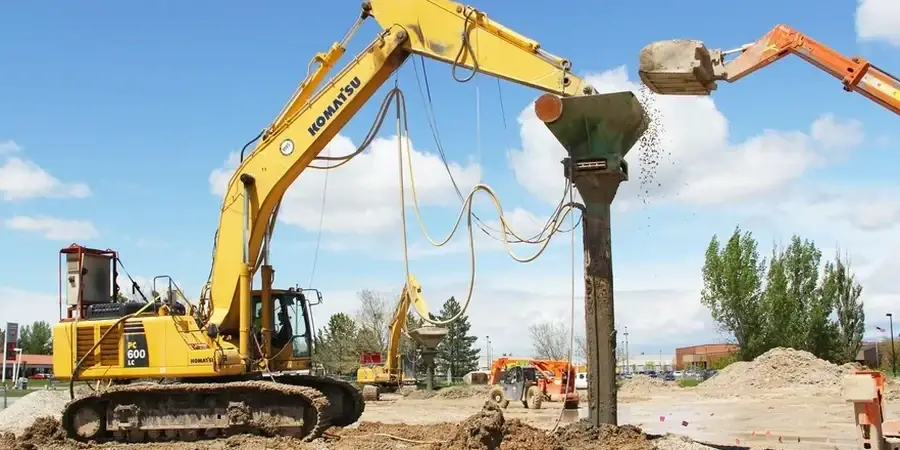
Greensboro’s expansion from a textile hub into a logistics and advanced manufacturing center has pushed construction into land that was once considered marginal. Much of the Piedmont Triad sits atop weathered saprolite and residual silts derived from the underlying granitic and metamorphic bedrock. These soils can lose strength rapidly when disturbed. For slab-on-grade warehouses off I-85 or industrial pads near the airport, a vibrocompaction design program becomes a practical necessity. We evaluate the in-situ density and fines content to determine if deep vibratory treatment can densify the deposit or if stone columns are required. The goal is always the same: achieve a uniform bearing response and keep total and differential settlements within the tolerances set by the structural engineer and the IBC.
A well-designed vibrocompaction grid can double the allowable bearing pressure on Greensboro’s residual silts while cutting total settlement by more than half.
Our approach and scope
Local context
Sites near downtown Greensboro and older mill-village redevelopments often sit on decades of undocumented fill, ash, and construction debris. These fills behave completely differently from the natural residual soils found just a few miles west toward the airport. In the western sector, you are dealing with reasonably predictable saprolite. In the central and eastern corridors, the fill thickness can vary from 3 to 15 feet across the length of a single building pad. Without a vibrocompaction design that accounts for this lateral variability, you risk differential settlement that cracks slab joints and shears utility connections. We map the transition zones using closely spaced CPT soundings and adjust the compaction grid density accordingly. Where fines exceed 20 percent, we switch the recommendation to stone columns or rigid inclusions because vibratory energy alone will not drain the excess pore pressure fast enough.
Regulatory framework
ASTM D5778 – Standard Test Method for Electronic Friction Cone and Piezocone Penetration Testing of Soils, ASTM D1586 – Standard Test Method for Standard Penetration Test (SPT) and Split-Barrel Sampling of Soils, IBC 2024 – Chapter 18 Soils and Foundations, ASCE/SEI 7-22 – Minimum Design Loads and Associated Criteria for Buildings and Other Structures
Related services
Performance-Based Compaction Design
We develop the vibrator specifications, probe grid, and pass sequence based on target relative density. The design references CPT or SPT data from our site investigation and includes a clear set of acceptance criteria for the specialty contractor.
Post-Treatment Verification and Reporting
After compaction, we execute the verification program: CPT soundings, plate load tests, and sand cone density checks. The final report compares pre- and post-treatment data and certifies that the ground improvement meets the design intent for the Greensboro building official’s review.
Typical parameters
FAQ
How do you decide if vibrocompaction will work on a Greensboro site?
It depends almost entirely on the fines content and the position of the water table. We run a grain-size analysis on samples from the upper 30 feet. If the material has less than 15 percent passing the #200 sieve and the groundwater is below the treatment zone, vibrocompaction is typically the most cost-effective solution. Between 15 and 20 percent fines, we may still proceed but with closer probe spacing and a longer dwell time. Above 20 percent, we recommend stone columns instead.
What is the typical cost range for a vibrocompaction design package in the Triad?
For a commercial or industrial pad in Greensboro, the design package including the CPT investigation, compaction grid layout, specifications, and post-treatment verification typically runs between US$1,440 and US$4,570, depending on the pad size and the number of verification tests required.
How long does the design process take?
We can usually deliver the draft design within 10 business days of completing the site investigation. The investigation itself takes 2 to 4 days in the field for a typical 2- to 5-acre site. If the project is on a fast track, we can phase the report and release the compaction grid early so the contractor can mobilize while we finish the verification protocol details.
What verification do Greensboro building officials expect?
The City of Greensboro follows the IBC, which requires that ground improvement be verified by a qualified geotechnical engineer. Our standard verification includes CPT soundings at a minimum of 5 percent of the compaction points plus at least one plate load test per 10,000 square feet of treated area. We include all the data in a signed, sealed report that the owner submits with the foundation permit application.