Greensboro sits on the weathered bedrock of the Carolina Slate Belt, where saprolitic silts and partially decomposed phyllite create retention challenges that shallow systems rarely solve. The water table in the Triassic basin sections can rise within eight feet of grade during wet seasons, adding hydrostatic pressure that must be accounted for in any anchor design. With a seismic classification of Site Class C or D depending on proximity to the Deep River fault traces, the lateral earth pressures here differ markedly from textbook assumptions. Our technical team approaches each active or passive anchor layout by first mapping the residual soil profile through drilling data, then selecting tendon type, bond length, and lock-off load to match the in-situ stiffness of the weathered rock. Where the grade change exceeds twelve feet, slope stability analysis becomes the starting point before any anchor geometry is finalized.
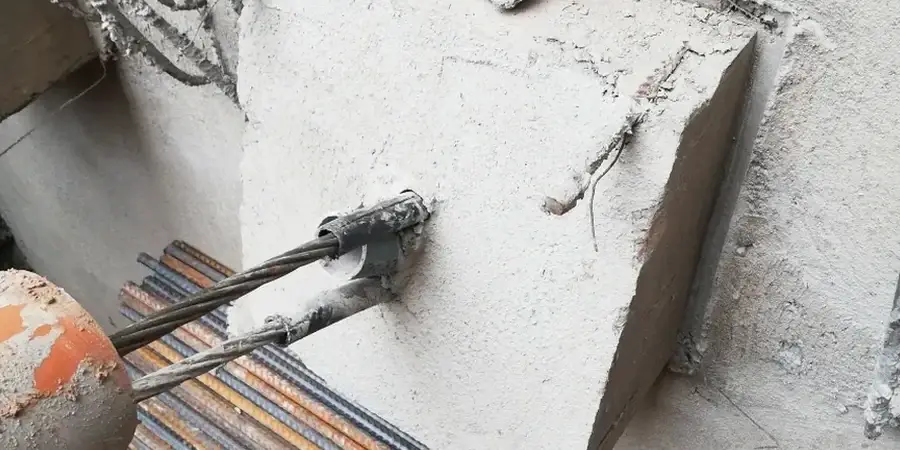
Lock-off loads in Greensboro saprolite are typically verified with lift-off tests 24 hours after stressing, capturing early creep before it affects wall alignment.
Our approach and scope
Local context
The contrast between the gently sloping Piedmont uplands of northwest Greensboro and the alluvial lowlands near Buffalo Creek illustrates why anchor design is never a one-spec-fits-all exercise. In the uplands, residual micaceous silts can lose apparent cohesion when saturated, shifting active wedge geometry and increasing anchor loads beyond the values predicted by Rankine theory alone. Down near the creek corridors, layered alluvium with organic lenses introduces creep potential that passive bar anchors may not resist unless the bond zone extends well into competent residual soil. Another risk unique to the region is the presence of graphite schist seams, which act as natural slip surfaces when exposed in excavation. Without probe drilling or a test pit investigation ahead of anchor installation, these seams can go undetected and compromise the entire retention system. The IBC requires a 1.5 factor of safety on ultimate bond for permanent anchors, but local practice pushes closer to 2.0 in weathered mica schist to account for progressive strength loss over the design life.
Regulatory framework
IBC 2021 – Section 1807 and 1810 (Retaining Walls and Deep Foundations), ASCE 7-22 – Minimum Design Loads for Buildings (Lateral Earth Pressure), PTI DC35.1-14 – Recommendations for Prestressed Rock and Soil Anchors, ASTM A416 – Standard Specification for Low-Relaxation Seven-Wire Steel Strand, ASTM C109 – Compressive Strength of Hydraulic Cement Mortars
Related services
Active Anchor Design and Load Testing
Full design cycle for strand anchors with lock-off loads up to 150 kips, including bond length calculations in saprolite, stressing sequence procedures, and on-site lift-off and creep testing. Documentation meets PTI DC35.1 and IBC submittal requirements.
Passive Bar and Tieback Systems
Solid-bar anchors and self-drilling hollow-bar systems for temporary shoring in Piedmont residual soils. Includes bar diameter selection, grout mix design for low-headroom installations, and pull-out testing per ASTM D3689.
Retaining Wall Global Stability with Anchors
Slope stability analysis integrating anchor forces into limit-equilibrium models. Evaluates compound failure surfaces behind anchored walls in weathered rock slopes, using Spencer or Morgenstern-Price methods with Greensboro-specific shear strength parameters.
Typical parameters
FAQ
When do you specify active anchors instead of passive tiebacks for a Greensboro excavation?
Active anchors are indicated when wall deflection must be controlled from the start, such as adjacent to existing structures or utilities. In Greensboro's saprolitic silts, active prestressing locks in a force that reduces lateral movement to fractions of an inch, whereas passive bars require soil deformation before engaging. For cuts deeper than 20 feet near downtown foundations, active systems with staged stressing are standard.
What is the typical cost range for anchor design and load testing in the Triad area?
Anchor design packages for Greensboro projects, including bond length calculations, corrosion protection detailing, and on-site load testing, typically range from US$1,060 to US$3,660 depending on the number of anchor levels and the complexity of the subsurface profile. Permanent anchors with double-corrosion protection and extended monitoring fall toward the upper end of that range.
How do you verify the bond zone capacity in partially weathered phyllite?
Verification starts with SPT or CPT data along the proposed bond length to identify the transition from residual silt to weathered rock. A sacrificial anchor is installed in each representative zone and subjected to a performance test loading to 133% of design load, monitoring creep over a 60-minute hold period. The acceptance criterion is creep below one millimeter per log cycle of time, per PTI DC35.1.
Does the IBC require a specific factor of safety for permanent anchors in residual soils?
The IBC references a minimum factor of safety of 1.5 on the ultimate bond strength for permanent anchors, but the Greensboro geotechnical community commonly adopts 1.8 to 2.0 in micaceous residual soils where strength degradation from moisture fluctuation is a known long-term concern. The higher factor is applied to the grout-to-ground bond, not to the tendon steel.