Greensboro sits at roughly 897 feet above sea level, straddling the boundary between the Triassic Basin's red clay and the deeper saprolitic soils of the Piedmont. That elevation isn't just a number—it means drainage pathways, frost-depth considerations, and a mix of weathered rock that can shift more than you'd expect under repeated axle loads. In our experience, rigid pavement design here has to account for the I-40 corridor's heavy truck traffic and the microclimates around the watersheds feeding Lake Brandt. We don't just look at concrete thickness; we look at what the subgrade will do after ten wet-dry cycles. For sites near the Guilford Courthouse National Military Park or the expanding industrial parks off I-840, we've learned that ignoring the residual soil structure can lead to curling stresses that no amount of rebar can fix. That's why our approach ties the geotechnical investigation directly to the joint layout—because in Greensboro, the soil profile often changes within a hundred feet. A proper plate load test gives us the modulus of subgrade reaction we need before we even start the structural design.
In Greensboro's saprolitic subgrades, the difference between a 20-year slab and a 5-year failure is often just two inches of well-compacted, open-graded subbase.
Our approach and scope
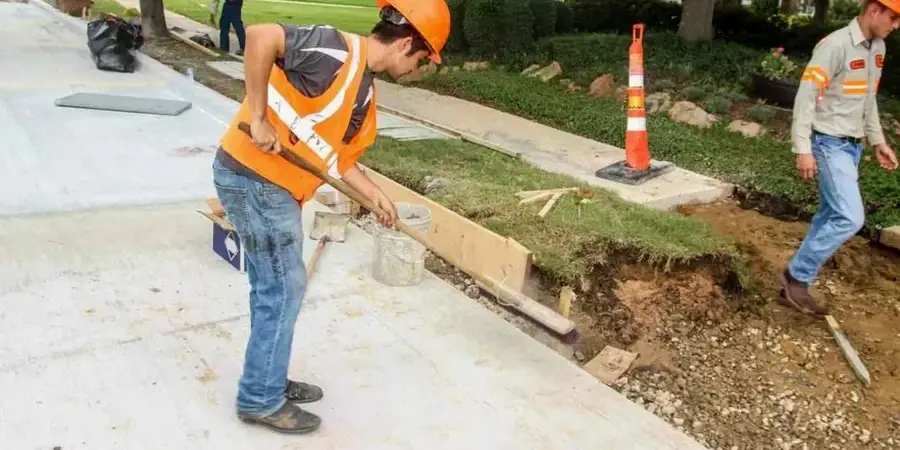
Local context
The weathered bedrock of the Greensboro area—locally called saprolite—poses a unique risk: it looks solid in an auger cutting but slakes into a soft, low-bearing material within hours of exposure to air and water. We've measured subgrade modulus values drop by 40% after a single heavy rain on an unsealed subbase. That kind of variability hits rigid pavements hard because the slab's stiffness concentrates stress at the joints. Another issue is the depth to refusal: borings around the Battleground Avenue corridor often hit shallow rock at 3 to 5 feet, but the rock surface is irregular, creating differential support conditions. If you don't catch that during the site investigation, you end up with pumping at the slab edges and progressive faulting. The IBC and ASCE 7 deliver the structural load framework, but the local track record tells us where to expect these transitions. We also deal with expansive fines in some of the Triassic basin sediments—not as severe as in Texas, but enough to cause warping if the moisture barrier isn't installed correctly.
Regulatory framework
AASHTO Guide for Design of Pavement Structures (1993, with NC DOT supplements), ASTM C78 / C78M-21: Standard Test Method for Flexural Strength of Concrete, ASTM D1196 / D1196M-21: Standard Test Method for Nonrepetitive Static Plate Load Tests of Soils, IBC 2021: International Building Code, Chapter 18: Soils and Foundations, ASCE 7-22: Minimum Design Loads and Associated Criteria for Buildings and Other Structures
Related services
Subgrade Evaluation & k-Value Determination
Field plate load tests and laboratory CBR correlations to establish the modulus of subgrade reaction for use in Westergaard-based thickness design.
Joint Layout & Detailing
Custom joint spacing plans based on slab geometry, climate data from PTI Airport, and anticipated truck loading patterns for distribution centers and industrial parks.
Concrete Mix Design & Quality Control
Mix designs targeting the required flexural strength with local aggregates, plus on-site slump, air content, and temperature monitoring during placement.
Typical parameters
FAQ
What does rigid pavement design cost for a project in Greensboro?
The fee for a complete rigid pavement design package—including subgrade investigation, thickness calculations, joint layout, and mix design—typically ranges between US$1,740 and US$5,540, depending on the slab area, traffic loading data, and the number of borings required to characterize the subgrade variability.
How deep should the subbase be under a rigid pavement in the Piedmont?
In Greensboro, we typically specify 4 to 6 inches of open-graded or cement-treated aggregate base. The exact depth depends on the subgrade soil type: saprolitic silts demand better drainage and often require the thicker end of that range to prevent pumping and erosion at the joints.
Do you design rigid pavements for municipal roads following NC DOT standards?
Yes, we reference the NC Department of Transportation Standard Specifications for Roads and Structures, adapting the AASHTO 93 design method with regional calibration factors that account for the freeze-thaw cycles and residual soil conditions common in the Triad area.
What causes random cracking in concrete slabs around Greensboro?
Most random cracking we investigate is tied to inadequate joint spacing for the local temperature range, or to differential support from irregular weathered rock surfaces. We address this by modeling thermal stresses with local climate data and by ensuring a uniform, well-compacted subbase across the entire slab footprint.