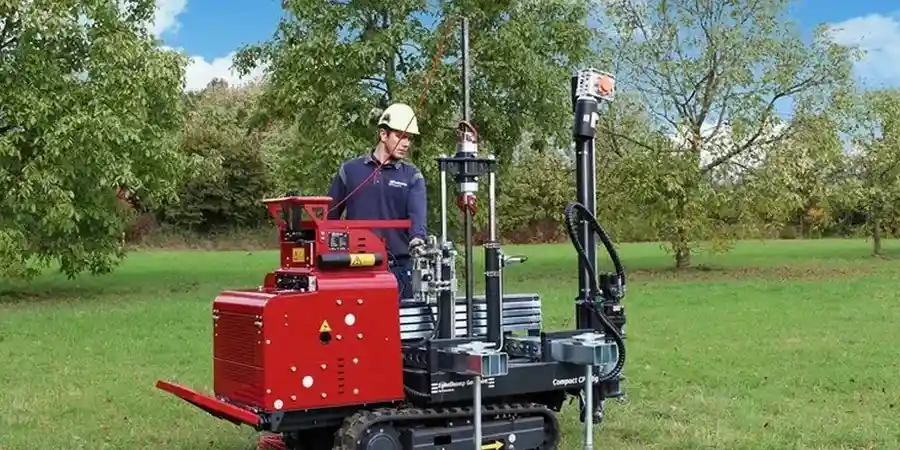
The red clay across Greensboro looks the same from the surface, but underneath the saprolite the Triassic basin tells a different story. Weathering depths shift abruptly—ten feet of stiff residual soil can give way to soft seams in less than twenty horizontal feet. That’s why cone penetration testing has become the go-to tool for Piedmont geotechnical work: it reads the transition zones that split-spoon samplers miss. We push a 60-degree cone into the ground at a constant 2 cm/s and log tip resistance, sleeve friction, and pore pressure simultaneously. For sites near the Haw River or along the I-85 corridor where fill thickness varies, the CPT profile removes the guesswork before a single footing is poured. Many Greensboro projects start with a few test pits to expose the top of the weathered rock, then switch to CPT to sound the overburden without disturbing the sensitive silty layers that lose strength when sampled.
One CPT sounding replaces eight split-spoon samples and gives you pore pressure dissipation data that a drill rig never will.
Our approach and scope
Local context
ASCE 7-22 classifies Greensboro within a region where site class determination cannot rely on SPT blow counts alone, particularly where saprolite retains relict structure that inflates N-values. A friction ratio spike of 4-6% inside what looks like stiff clay often signals a partially weathered diabase dike—one of the most misidentified features in Guilford County geotechnical reports. If that material gets classified as competent rock instead of transitional weathered material, settlement predictions shift by half an inch or more. Pore pressure dissipation tests during the CPT catch these layers because the u2 sensor shows slow decay, confirming low permeability that a split spoon will never measure. When the same profile feeds into a footing design that assumes uniform stiffness, differential movement becomes a real risk on the column lines that straddle the dike contact. The CPT data set flags those contacts before the structural engineer draws the first foundation plan.
Regulatory framework
ASTM D5778 – Electronic Friction Cone and Piezocone Penetration Testing of Soils, ASTM D7400 – Downhole Seismic Testing (SCPTu method), ASCE 7-22 – Seismic Site Classification using Vs and CPT data, IBC 2021 – Foundation investigation requirements for site-specific bearing capacity
Related services
Standard CPTu sounding
Continuous log of tip resistance, sleeve friction, and pore pressure. Delivered as digital .COR files and a printed log with soil behavior type chart per Robertson 1990.
Seismic CPT (SCPTu)
Same cone plus a triaxial geophone that measures shear wave velocity at meter intervals. Used for IBC site class determination and liquefaction triggering analysis.
Dissipation test package
Pore pressure decay curves recorded at specified depths. t50 values converted to coefficient of consolidation for time-rate settlement analysis in Piedmont silts.
CPT-to-SPT correlation report
Conversion of qc to equivalent N60 using region-specific correlations validated against nearby SPT borings. Includes friction ratio classification charts.
Typical parameters
FAQ
How much does a cone penetration test cost in Greensboro?
A standard CPTu sounding in the Greensboro area runs between US$170 and US$220 per test location, depending on depth and whether seismic measurements are added. Mobilization across Guilford County is quoted separately based on the number of soundings.
Can CPT replace SPT borings entirely on a Greensboro project?
In many Piedmont residual soils it can. CPT gives a continuous qc and friction ratio profile that maps soil behavior type without disturbing the sample. However, if the engineer needs an actual soil specimen for Atterberg limits or triaxial testing, we pair CPT with a few targeted SPT borings to recover samples at key depths.
What depth can you reach with CPT in Triassic basin geology?
In the mudstones and sandstones common around Greensboro, our 20-ton rig typically reaches 60 to 80 feet before refusal. When the cone hits hard rock at shallower depths—common near the Guilford County ridge lines—we stop at refusal and note the depth on the log.
How fast can I get CPT results after the field work?
The digital log is generated on-site. We email the .COR file and a draft PDF the same day. Seismic CPT processing for Vs profiles and site class letters usually follows within 24 hours because the shear wave picks need a manual quality check.