Greensboro sits squarely in the Triassic Basin and Piedmont physiographic province, where residual silty sands and partially weathered bedrock dominate the subsurface. The Guilford County Building Inspections office enforces the 2021 North Carolina Building Code, which incorporates IBC Chapter 18 and ASCE 7. That means foundation designs in zip codes 27401 through 27410 must be backed by defensible geotechnical data. The Standard Penetration Test remains the most practical way to generate that data. Our SPT rigs mobilize across Greensboro neighborhoods from Lindley Park to Adams Farm, drilling through the saprolite zone to reach competent rock. Each blow count is recorded in strict accordance with ASTM D1586, and disturbed samples are logged following ASTM D2487 classification procedures. The resulting report gives structural engineers the N-values, soil descriptions, and groundwater observations they need to size footings correctly and satisfy plan review requirements.
A properly calibrated SPT hammer and continuous sampling through the saprolite zone give Greensboro engineers the data they need to avoid over-excavation claims.
Our approach and scope
Local context
Soil conditions change fast across the city. A site near Buffalo Creek might encounter soft alluvial deposits with N-values under 8, while just a mile west off Battleground Avenue the refusal depth hits at 15 feet in dense saprolitic material. The difference in allowable bearing pressure between these two profiles can exceed 2,000 psf. If the SPT program is too shallow, the engineer might design for a false refusal on a floating boulder in the saprolite layer. If the hammer energy isn't calibrated to the 60 percent standard, the raw N-values will overestimate or underestimate the actual soil strength. Both errors lead to expensive change orders after excavation starts. In the deeper Triassic Basin sediments north of I-40, we also watch for decomposing feldspar zones that soften dramatically when exposed to air and water. A carefully executed SPT boring catches these layers before they become a construction problem. For sites with high silt content, the geotechnical investigation often benefits from including a liquefaction potential analysis when seismic settlement is a concern under ASCE 7 Chapter 21 design criteria.
Regulatory framework
ASTM D1586 — Standard Test Method for SPT and Split-Barrel Sampling, ASTM D2487 — Classification of Soils for Engineering Purposes, IBC 2021 / North Carolina Building Code Chapter 18, ASCE/SEI 7-22 — Minimum Design Loads, NCDOT Standard Specifications Section 800
Related services
SPT Borehole Drilling & Sampling
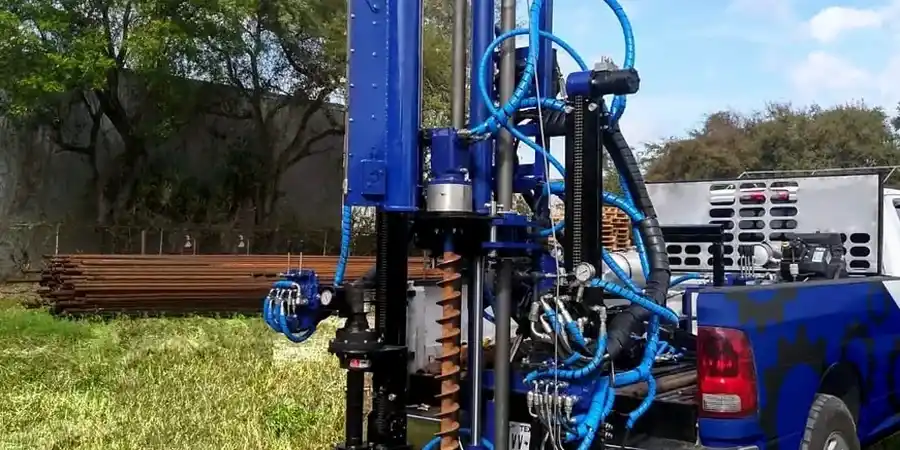
Mobilization of a truck-mounted CME-75 rig with automatic hammer to drill through fill, alluvium, and residual soil. Continuous split spoon sampling every 2.5 feet per ASTM D1586 with field classification of all recovered material.
Laboratory Index Testing
Particle size analysis, Atterberg limits, and natural moisture content determination on selected SPT samples. Used to confirm field classifications and group soil into USCS categories for the foundation report.
Foundation Engineering Report
A comprehensive geotechnical report signed by a North Carolina PE. Includes boring logs with N-values, groundwater data, allowable bearing capacity calculations, and foundation recommendations for footings or deep foundations per IBC 2021.
Typical parameters
FAQ
What does an SPT boring program cost for a standard residential lot in Greensboro?
For a single-family home site in Guilford County, a typical SPT investigation with two boreholes to 20-25 feet depth falls between US$510 and US$820 per boring. The total depends on access conditions, depth to refusal, and whether laboratory testing is needed for expansive clay confirmation. A site with poor access requiring a portable rig may run toward the upper end of that range. We deliver a firm quote after reviewing the site address, proposed structure footprint, and any prior geotechnical data available for the neighborhood.
How deep do SPT borings need to go in Greensboro's Piedmont soils?
Most borings extend to auger refusal in partially weathered rock, which typically occurs between 15 and 35 feet in Greensboro. The IBC requires borings to extend through any questionable fill or soft strata and into competent bearing material. For a shallow foundation design, we need at least 10 feet of continuous N-value data below the proposed footing elevation. If refusal is shallow, we core into the rock to verify it is not a floating boulder. The exact depth is determined in the field by the geotechnical engineer based on real-time blow count observations.
How quickly can I get the SPT report after the field work is complete?
A standard residential or light commercial SPT report with boring logs, soil classifications, and foundation recommendations is delivered in five to seven business days after the field work wraps up. If laboratory testing is required for Atterberg limits or grain size analysis, add two to three additional days for the lab turnaround. We can accommodate rush review for an additional fee when a contractor is waiting on a building permit and the foundation excavation is scheduled. The report is emailed as a signed PDF ready for Guilford County plan review submission.