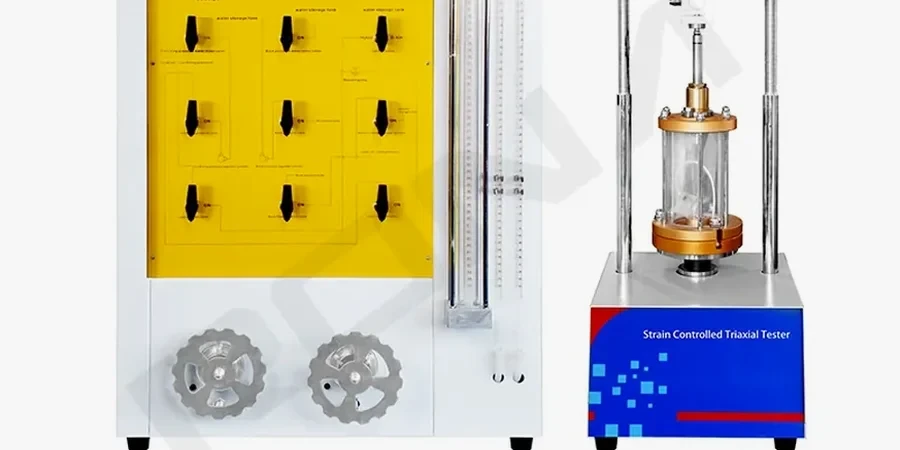
High-rise development along North Elm Street often encounters the transition zone between completely weathered rock and residual silt. On a recent project near Friendly Center, the upper 25 feet of profile looked competent during SPT drilling, but the contractor suspected cemented fabric that disaggregates under deviatoric stress. Without a consolidated-undrained triaxial test, that fabric gets mistaken for rock. Our lab in Greensboro runs ASTM D4767 and D2850 protocols on Shelby tube samples recovered from the saprolite, measuring effective friction angles that typically range from 28 to 34 degrees in the Gneiss-derived silts. We report drained and undrained strength envelopes so the geotechnical engineer can design footings with realistic bearing capacity factors. For projects where sample disturbance is a concern, we also recommend pairing the triaxial series with a CPT test to cross-check in-situ tip resistance against lab-derived undrained shear strength.
Triaxial testing on Piedmont residual soil gives you the effective friction angle and cohesion intercept that transform a conservative guess into a defensible foundation design.
Our approach and scope
Local context
The IBC requires that foundation bearing capacity be established using strength parameters representative of in-situ conditions. In Greensboro, where the saprolite can lose 60% of its intact strength upon saturation, using unconfined compressive strength alone violates the intent of Section 1803.5.4. The 2020 Cone Boulevard embankment failure investigation showed cohesive fill that tested at 2,200 psf in pocket penetrometer passed a CU triaxial at only 900 psf effective cohesion, explaining the rotational slide that shut down the ramp for three months. The triaxial test reveals this strength loss before construction begins. It also provides the modulus values needed to estimate settlement under the sustained dead load of a five-story steel frame, preventing the differential movement that cracks brick veneer and pops glass curtainwall seals.
Regulatory framework
ASTM D4767 - Standard Test Method for Consolidated Undrained Triaxial Compression Test for Cohesive Soils, ASTM D2850 - Standard Test Method for Unconsolidated-Undrained Triaxial Compression Test on Cohesive Soils, ASTM D7181 - Standard Test Method for Consolidated Drained Triaxial Compression Test for Soils, IBC Section 1803 - Geotechnical Investigations, ASCE 7 - Minimum Design Loads and Associated Criteria for Buildings and Other Structures
Related services
Consolidated-Undrained (CU) with Pore Pressure
The standard for Greensboro foundation design. Measures effective stress strength parameters (c', φ') under back-pressure saturation, with pore pressure transducers recording u during shear. Suitable for short-term loading on normally consolidated clays and silts.
Unconsolidated-Undrained (UU) Quick Triaxial
Rapid assessment of total stress strength for preliminary design. Three specimens sheared at different confining pressures without saturation or consolidation. Common for stiff, unsaturated Piedmont clays where suction dominates short-term strength.
Consolidated-Drained (CD) with Volume Change
Long-term drained strength for slope stability and permanent retaining walls. Shearing at 0.01%/min strain rate allows full pore pressure dissipation. Volume change measurement provides dilatancy angle for advanced constitutive models.
Typical parameters
FAQ
What is the cost of a triaxial test suite in Greensboro?
A standard three-specimen CU triaxial suite with back-pressure saturation, consolidation, and shear plus a Mohr-Coulomb envelope report typically ranges from US$1,880 to US$2,470, depending on the confining stress range and whether multi-stage testing is used to reduce sample quantity requirements.
How does the triaxial test differ from unconfined compression for Greensboro soils?
Unconfined compression provides a single undrained strength value with no confining pressure and no pore pressure measurement. The triaxial test applies controlled confining stress that replicates the in-situ overburden, measures pore pressure response during shear, and yields effective stress parameters (c', φ') that are independent of drainage conditions — essential when designing footings on saturated Piedmont silt.
What sample quality do you require for a CU triaxial test?
We require undisturbed Shelby tube samples with a minimum diameter of 2.4 inches and a length-to-diameter ratio of 2.0 to 2.5. Tubes must be sealed with wax immediately after extrusion in the field and transported in cushioned racks to prevent vibration damage. Disturbed samples or those with visible cracks, swelling, or desiccation rims will not yield reliable effective stress parameters.
Can you run triaxial tests on partially saturated residual soil from Greensboro?
The reference range for this service in Greensboro is US$1.880 - US$2.470. The final price depends on the project scope and volume.
How long does a triaxial testing program take from sample receipt to final report?
A standard CU triaxial suite requires 10 to 14 business days. Saturation and consolidation phases can each take 24 to 72 hours depending on soil permeability — Piedmont silts typically consolidate within 24 hours at the design stress. Shear phase runs 4 to 6 hours per specimen. We deliver preliminary effective stress parameters within 5 business days if the schedule is critical.