Greensboro sits squarely on the Piedmont Plateau, where the bedrock is draped in thick blankets of residual silty clay. Saprolite depths across Guilford County often exceed 40 feet before reaching partially weathered rock. A soil mechanics study here is not a generic checklist item. It is a forensic look at how these ancient decomposed materials will behave under load. The region's kaolinitic clays swell less than montmorillonite-rich soils elsewhere, but their structure is fragile. Disturbance during sampling collapses the natural fabric. We quantify this sensitivity through careful field extraction and laboratory consolidation testing. For deeper investigation where SPT refusal is a risk, we pair the soil mechanics study with CPT testing to map the transition from stiff clay to weathered rock without losing stratigraphic detail.
Piedmont residual soils lose up to 60% of their undisturbed strength when remolded. A soil mechanics study must measure that sensitivity before construction begins.
Our approach and scope
Local context
The contrast between Greensboro's wet winters and dry late summers creates a shrink-swell cycle that fatigues shallow foundations over decades. A soil mechanics study must capture the soil's moisture retention curve, not just a snapshot condition. Residual micaceous silts common in the northern parts of the city drain slowly. Pore pressure dissipation can lag months behind the end of a rainy season. If the study only reports peak strength from a dry summer boring, the winter bearing capacity may be dangerously overestimated. We target boring campaigns in representative seasonal conditions and run suction-controlled tests when the project schedule allows. Overlooking this seasonal variance is the single most common trigger for differential settlement claims in Greensboro residential and light commercial work.
Regulatory framework
ASTM D1586 (Standard Penetration Test), ASTM D2487 (Unified Soil Classification), ASTM D4767 (Consolidated-Undrained Triaxial), IBC Chapter 18 (Soils and Foundations), ASCE 7 (Minimum Design Loads)
Related services
Subsurface Exploration
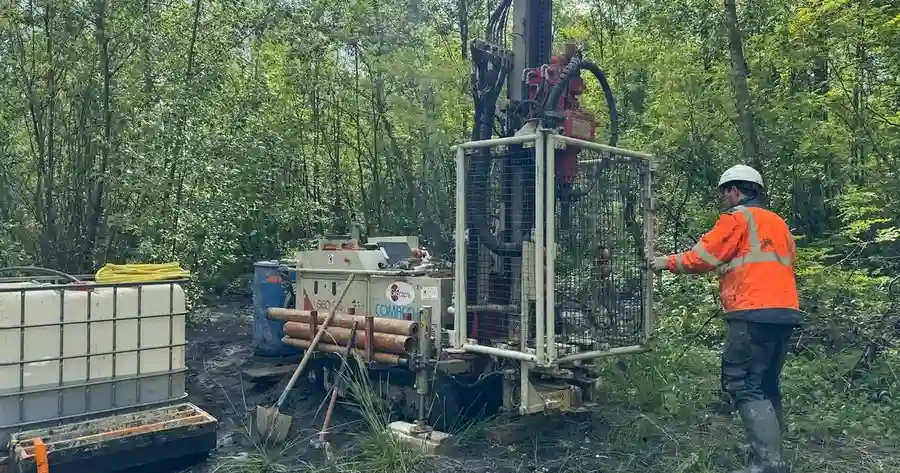
Drilling and sampling across the site using hollow-stem augers. Shelby tubes extracted at depths of engineering interest. Groundwater observation during boring. Logs prepared to ASTM D2488 for field classification before lab confirmation.
Laboratory Testing Program
Full index and strength testing suite. Moisture, density, Atterberg limits, grain size with hydrometer, one-dimensional consolidation, and triaxial shear. All procedures under our ISO 17025-accredited lab quality system.
Engineering Analysis & Report
Settlement prediction using oedometer data. Bearing capacity calculation for shallow and deep foundations. Lateral earth pressure coefficients for retaining structures. Recommendations sealed by a North Carolina licensed professional engineer.
Typical parameters
FAQ
What does a soil mechanics study cost for a single-family lot in Greensboro?
For a typical residential lot requiring one or two borings and a full lab suite, the study ranges from US$2,700 to US$4,590. The spread depends on boring depth, number of Shelby tube samples, and whether triaxial or just direct shear testing is specified by the structural engineer.
How deep do you need to drill for a soil mechanics study in the Piedmont?
Depth depends on the foundation type and the refusal horizon. For shallow footings, we typically advance borings to 20-30 feet below grade. If the saprolite is thick and we need to confirm auger refusal on rock, depths can extend to 50 feet or more. The boring plan is always discussed with the geotechnical engineer before mobilization.
What lab tests are mandatory for a Greensboro building permit?
The City of Greensboro reviews geotechnical reports against IBC Chapter 18 requirements. At minimum, the report must include soil classification, moisture-density relationship, and a bearing capacity recommendation. We always recommend adding consolidation and shear strength testing when the profile includes soft or compressible clays, because the permit reviewer will flag settlement risk if it is not addressed quantitatively.
How long does it take to get the final soil mechanics report?
Fieldwork is typically completed in one to two days. Laboratory testing runs ten to fifteen business days depending on the consolidation and triaxial queue. The draft report is delivered within three weeks of sampling, with the sealed final version following within a few days after client review. Expedited turnaround is available for projects with tight permit deadlines.