The Piedmont Triad’s residual soils present a unique challenge for heavy construction in Greensboro. Beneath the rolling topography shaped by ancient mountain erosion, contractors frequently encounter compressible silts and soft alluvial deposits near stream crossings like Buffalo Creek. Standard shallow footings simply cannot perform reliably in these conditions without excessive settlement. Stone column design offers a proven ground improvement method that reinforces weak strata by installing compacted gravel columns, increasing bearing capacity and accelerating consolidation. For projects near the watersheds that feed Lake Townsend, integrating a CPT test early in the investigation helps map the soft zones precisely, ensuring the stone column grid is optimized from the start.
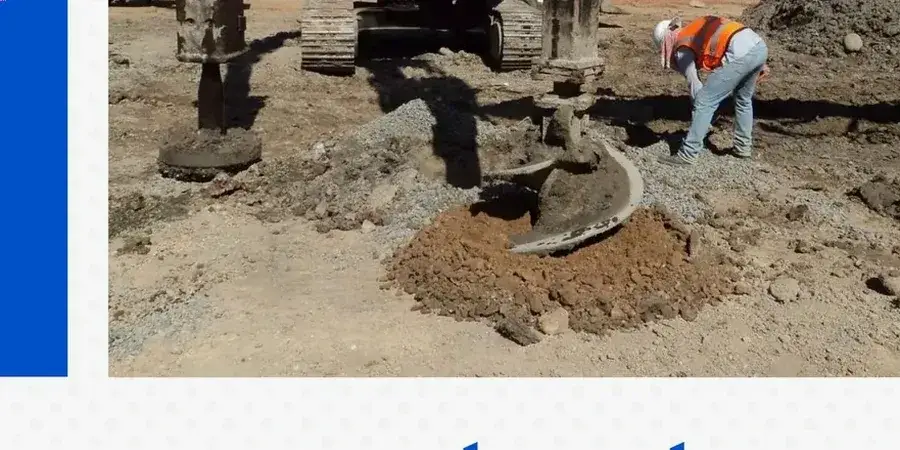
In Greensboro’s Piedmont geology, stone columns function as both vertical drains and load-bearing elements, turning compressible silts into a competent foundation layer.
Our approach and scope
Local context
With a population exceeding 300,000 in a growing metropolitan area, Greensboro’s development pressure means more structures are proposed on ground with high liquefaction potential or undocumented fill from the city’s mid-century expansion. The USGS seismic hazard maps confirm the region’s moderate risk of deep earthquakes originating in the eastern Tennessee seismic zone, a threat that amplifies the need for ground improvement in saturated deposits. Skipping a proper stone column design on a site with loose, water-charged soils can lead to differential settlement exceeding 3 inches within the first five years—enough to shear utility connections and crack masonry. The biggest liability arises when columns are installed without granular blanket verification or post-installation modulus tests, leaving the owner with an expensive repair scenario that costs four times the original improvement.
Regulatory framework
ASTM D1586 (Standard Penetration Test), ASTM D2487 (Soil Classification), ASCE 7-22 (Minimum Design Loads), IBC 2024 (International Building Code), FHWA-NHI-16-027 (Ground Improvement)
Related services
Site-Specific Column Layout
We develop optimized triangular or square grid patterns based on your foundation loads and the compressibility profile derived from SPT borings across the Greensboro site.
Aggregate Specification & Sourcing
Our lab defines the gradation envelope for crushed stone that meets ASTM D2487 criteria, ensuring high internal friction and resistance to clogging in the Triad’s silty groundwater.
Vibro-Replacement Procedure Design
We specify the vibroflot horsepower, amperage targets, and lift thicknesses to achieve consistent column density from the bearing stratum up to the working platform.
Post-Installation Verification
Using plate load tests and modulus measurements, we confirm that the installed columns meet the design stiffness and deliver the specified settlement reduction for your Greensboro structure.
Typical parameters
FAQ
What does stone column design cost for a typical Greensboro warehouse site?
For a mid-sized commercial lot in the Greensboro area, stone column design and testing typically ranges from US$1,540 to US$5,820. The final figure depends on the number of borings, the depth of soft soil, and the complexity of the load-testing program required to satisfy IBC Chapter 18.
How do stone columns perform in Greensboro’s red clay residual soils?
Unlike purely cohesive northern clays, Greensboro’s saprolitic soils retain some relict structure from the parent bedrock. Stone columns work by displacing the softest pockets and creating a densified annulus. The high silt content of our local soils means drainage is slower, so we often design a thicker granular blanket layer to efficiently route pore water expelled during surcharge loading.
When is stone column design preferred over deep foundations in the Triad region?
When the weak zone is continuous but relatively shallow—typically 15 to 35 feet deep—stone columns become more economical than driven piles. For large-area structures like slab-on-grade warehouses or embankment supports near Greensboro’s industrial parks, the column grid distributes loads uniformly and eliminates the need for structural pile caps, saving both time and concrete volume.
What soil investigation data does the design team need before starting?
We require Standard Penetration Test (SPT) data at regular depth intervals, grain size distributions per ASTM D2487, and Atterberg limits on the cohesive layers. Cone penetration data is highly valuable for delineating the exact thickness of soft lenses. This information lets us model the composite stiffness and set the replacement ratio accurately before any rig mobilizes to the Greensboro site.