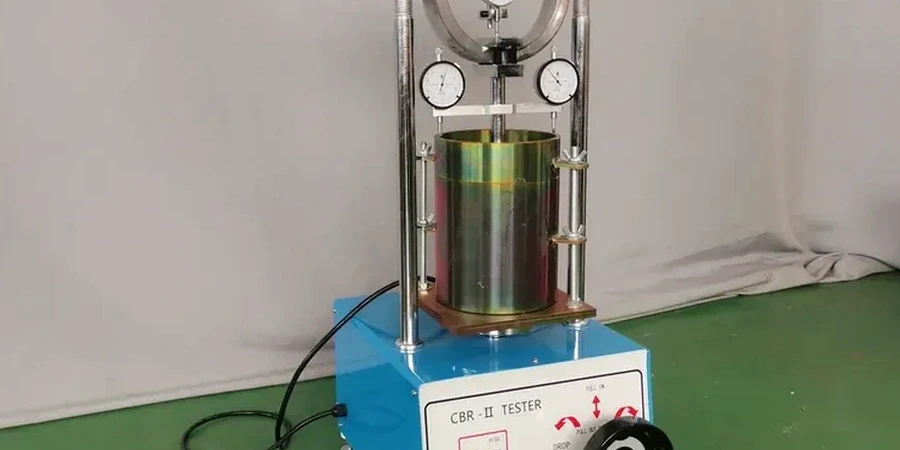
Greensboro sits on the Triassic Basin, where saprolitic silts and micaceous clays derived from weathered bedrock dominate the shallow subsurface. These Piedmont residual soils can lose significant strength when saturated, a condition we see often after heavy summer thunderstorms. That is where the laboratory CBR test becomes essential. It is a direct empirical input for flexible pavement design, and skipping it on a project here can lead to under-designed base courses. Our laboratory runs the procedure under controlled moisture and density conditions, following AASHTO T 193, so the soaked CBR value reflects worst-case field conditions. Before we compact a sample, we often pair the test with a grain size analysis to confirm fines content and with Atterberg limits to check the plasticity of those troublesome Piedmont silts. The result is a pavement section that holds up against Greensboro’s freeze-thaw cycles and seasonal groundwater fluctuations.
A soaked CBR value is what the subgrade will actually give you after a wet Greensboro winter, not what it promises on a dry day.
Our approach and scope
Local context
The seasonal contrast in Greensboro, from dry autumns to saturated early springs, means a subgrade tested at natural moisture can be misleadingly optimistic. We have seen unsoaked CBR values in local sandy silts exceed 20% while the soaked equivalent drops below 6%, a difference that translates directly into additional aggregate base thickness. The Piedmont’s residual micaceous soils are also prone to swell during the 96-hour soak, so ignoring the swell measurement is a real risk. A pavement designed on unsoaked data will rut and crack within the first two years. Our lab documents both the load-penetration curve and the swell percentage, so the pavement engineer can apply the correct structural number. When the CBR comes back low, we discuss stabilization options or recommend a CBR test on the road base material itself to verify the imported aggregate meets North Carolina DOT specifications.
Regulatory framework
AASHTO T 193: Standard Method of Test for CBR of Laboratory-Compacted Soils, ASTM D1883: Standard Test Method for CBR of Laboratory-Compacted Soils, NCDOT Standard Specifications for Roads and Structures, Section 500
Related services
Soaked Laboratory CBR
We compact specimens at optimum moisture to modified Proctor density, submerge them for 96 hours, and record load-penetration up to 0.5 inches. The report includes corrected CBR at 0.1” and 0.2”, swell percentage, and moisture content before and after soaking.
CBR on Imported Base Aggregate
For projects using ABC stone or select fill, we test the material itself to confirm it meets NCDOT minimum CBR requirements. This avoids the costly mistake of placing under-spec aggregate under a parking lot or roadway.
Typical parameters
FAQ
What is the typical turnaround time for a laboratory CBR test in Greensboro?
A standard soaked CBR takes about 6 to 8 business days from sample receipt to report. The 96-hour soaking period is fixed by AASHTO T 193, and the compaction plus penetration testing adds another day or two. We can expedite for an additional fee if the schedule is tight.
How much does a laboratory CBR test cost?
For a single-point soaked CBR on a bulk sample, you are generally looking at US$150 to US$230. The three-point method, which plots the full moisture-density-CBR relationship, runs higher because it requires three separate compaction molds and more lab time. We always quote per project based on the number of samples and the testing configuration.
Do you need a disturbed or undisturbed sample?
A disturbed bulk sample is standard for the laboratory CBR. We need about 50 pounds of material per point. The sample should be sealed in a plastic bag immediately after excavation to preserve natural moisture, and we prefer to receive it within 24 hours. For Greensboro’s saprolitic silts, moisture loss can skew the optimum water content and the resulting CBR.
What CBR value does NCDOT require for subgrade?
NCDOT typically looks for a soaked CBR of 6% or higher for subgrade under flexible pavements. Values below that often trigger a subgrade stabilization requirement, such as lime treatment or a thicker aggregate base. We include the NCDOT threshold on the report so the design engineer can make an immediate call.